“I am pleased to know that my grandfather’s letters will find their last home amongst the regimental records and you are most welcome to make whatever use of them you think fit.”
This is an extract from a letter received by the KOSB Museum in March, 1978. It accompanied a small collection of letters dating between 1862 and 1865, written by a young recruit called Robert McIntosh, the grandfather of the person who donated the letters 116 years later. In the late autumn of 1862, Robert McIntosh left his ancestral croft at Balchlaggin, Rogart, Sutherland, and travelled to Edinburgh in the hope of joining the army.
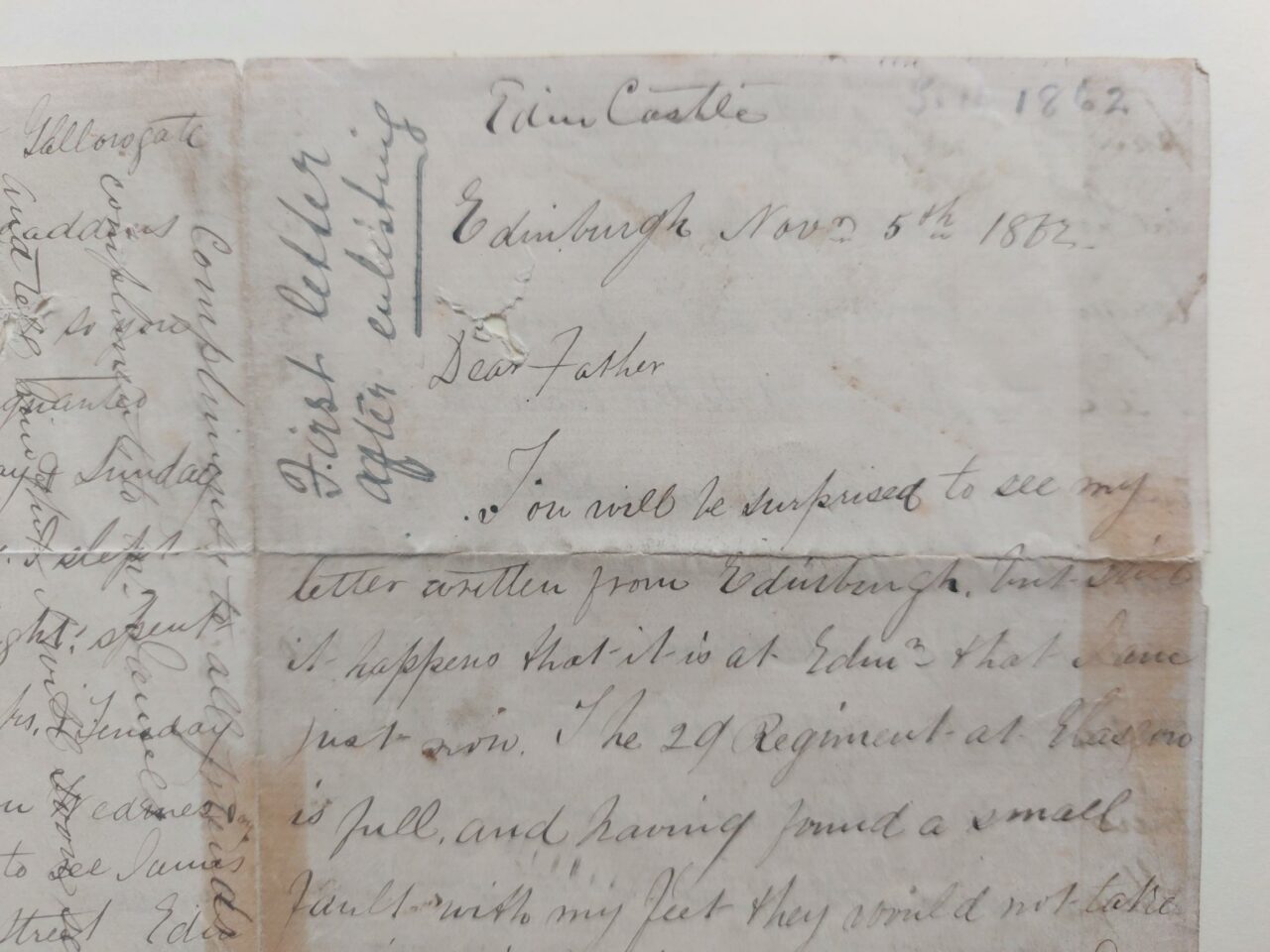
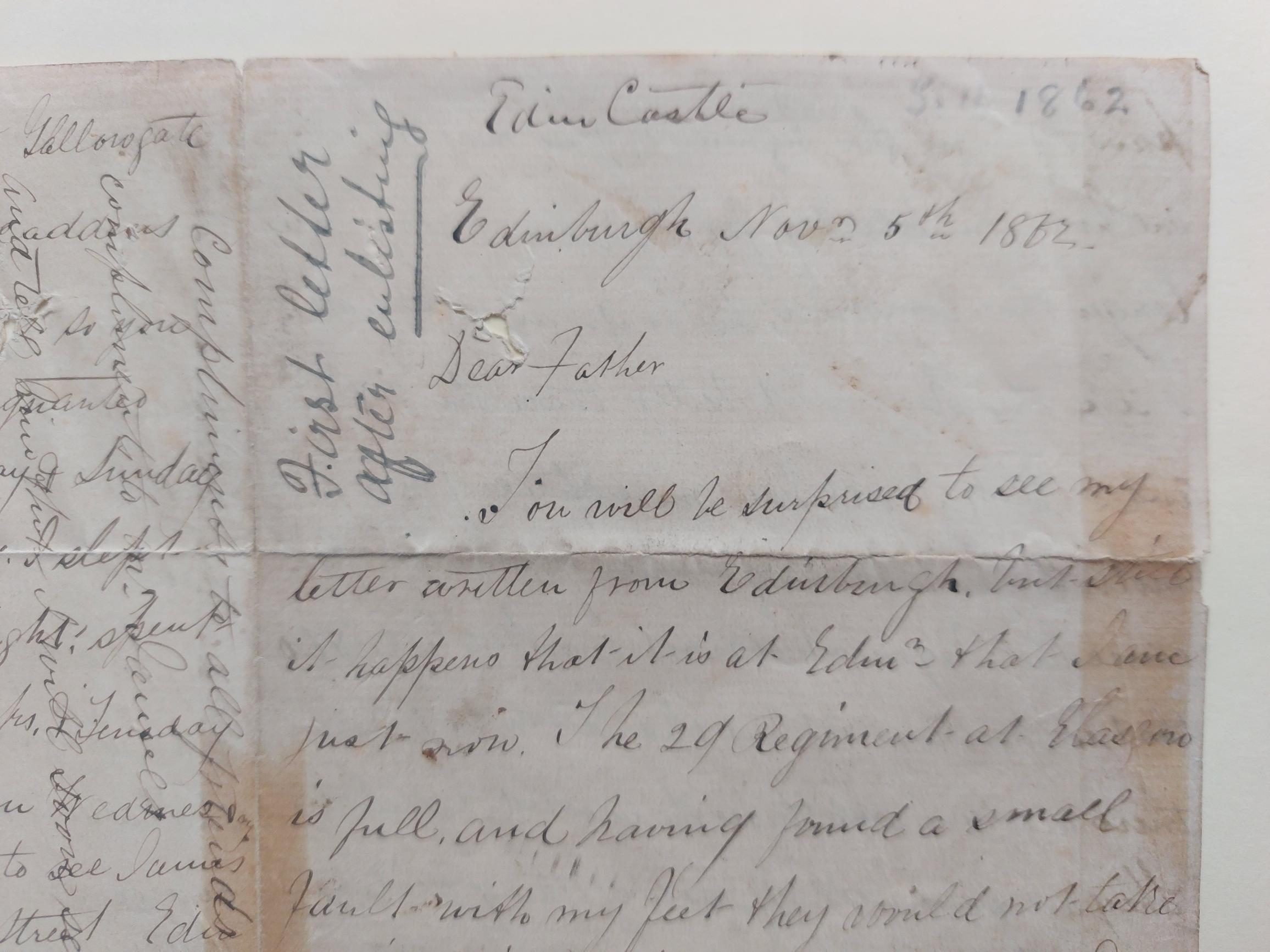
Dear father,
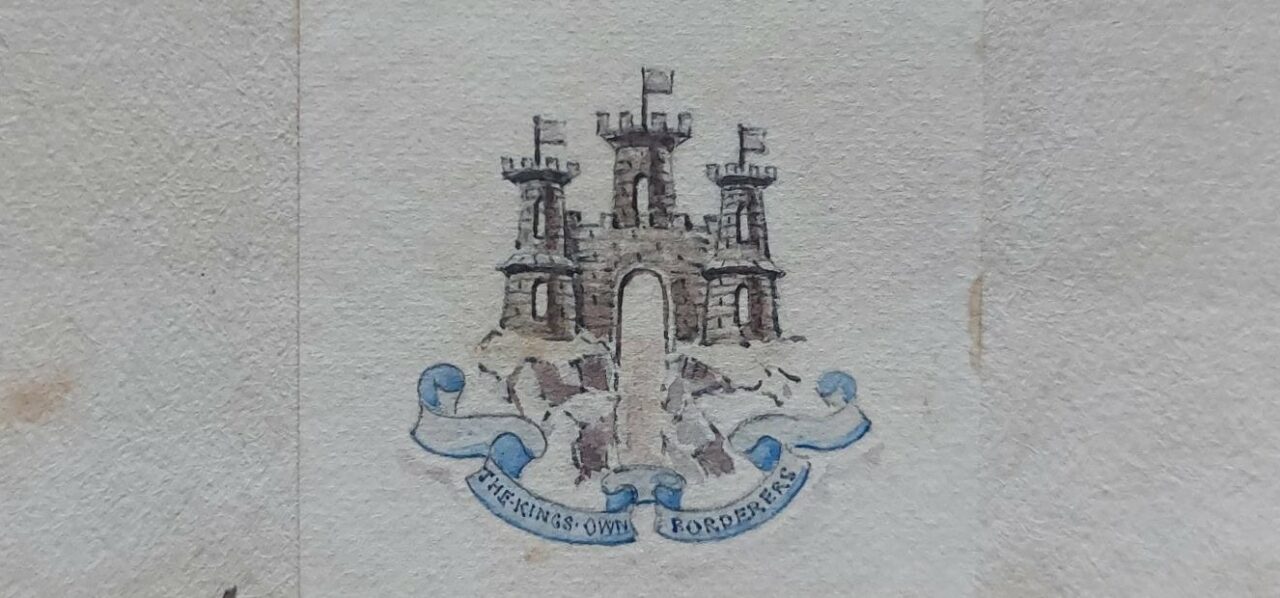
You will be surprised to see my letter written from Edinburgh, but still it happens that it is at Edinburgh that I am just now. The 29 Regiment at Glasgow is full, and having found a small fault with my feet, they would not take me into the Regiment (the fault the doctor found was that I was flat-footed). So I came to here on the 4th November, that is yesterday, and I intend listing into the 25th Regiment. They are called The King’s Own Borderers. I will be listed tomorrow, because the Colonel is not at home today. If I do not pass here in the Regiment, you may expect me home on Saturday, for I will not stay here longer than tomorrow, that is if I am not listed.
The King’s Own Borderers at the time mustn’t have been too bothered about how arched one’s feet were, because, by the time he writes again, Robert is a fully enlisted Borderer.
I like the Regiment better than the 29th and I think I will have more chance of promotion in it, for they are all young men because the Regiment was not enrolled till 1860, that is there was not but one battalion, but now there are two and this is the second battalion.
And so, Robert becomes part of the 2nd Battalion KOB, which had been raised at Preston in 1859 and moved to Edinburgh in 1862.
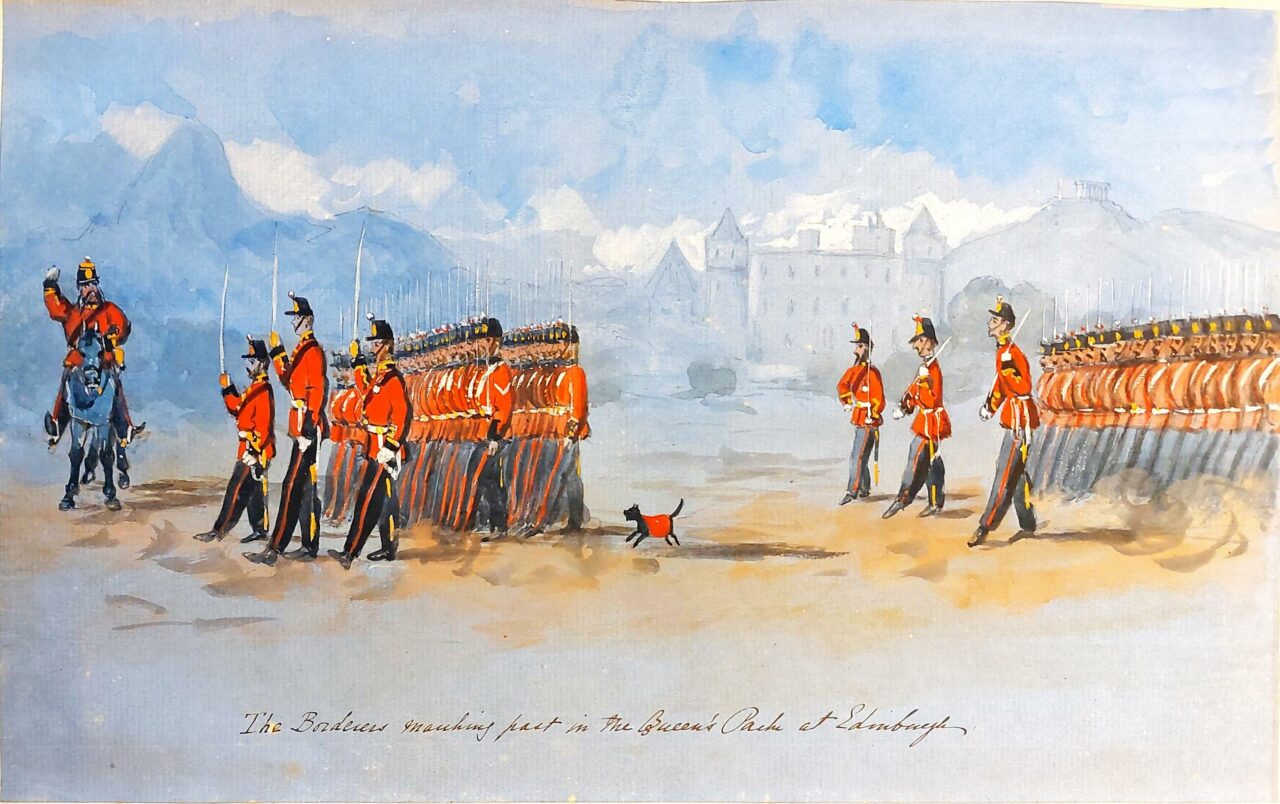
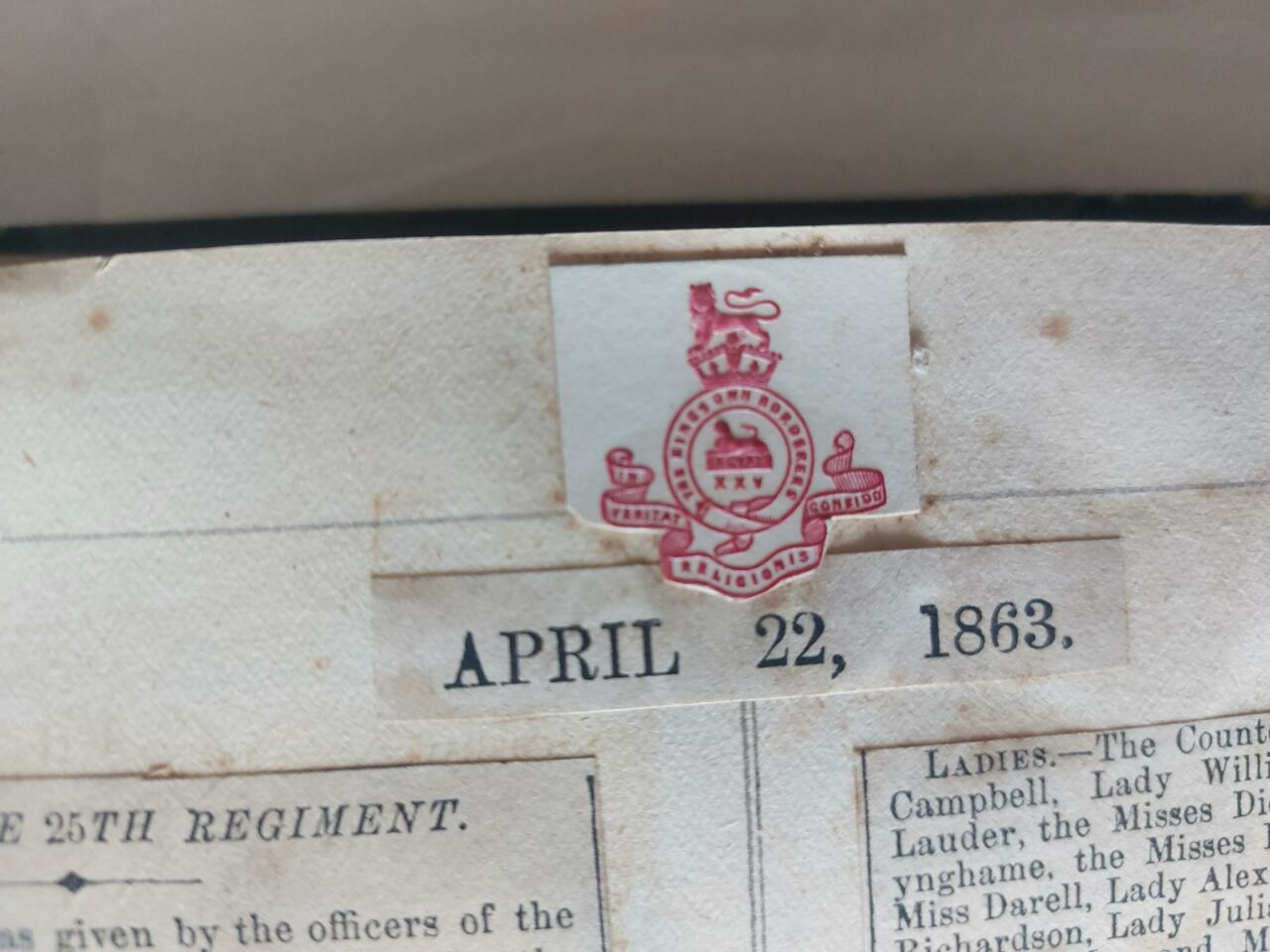
Whenever I find something in the archives, I go through a connecting process. The first part is between me and the letters or images in front of me, immersing myself in the words, the story, the tone. I then start making links between other things I’ve researched, people I know would have been in the same battalion, serving in the same time and place, and create a contextualised world for each archive item. Knowing that Robert McIntosh was part of the 2nd Battalion KOB in the 1860s, I remembered a weighty scrapbook compiled by Captain Turner. Same time, same battalion, different social spheres but with some crossover of experience. Turner includes a detailed account of how, in April 1863, the battalion was presented with its Regimental Colours. The ceremony took place in Queen’s Park, Edinburgh and they were presented by Lady Juliana Walker, wife of Major-General Walker. Robert McIntosh is likely to have taken part in the day. With his usual level of humour, colour and detail, talented watercolour artist and officer of the Regiment, George Frederick Coleridge, paints a scene at Queen’s Park during that period. Again, Coleridge was part of 2nd Battalion KOB and had travelled with them to Canada the year before, sketching and recording the experience as he went.
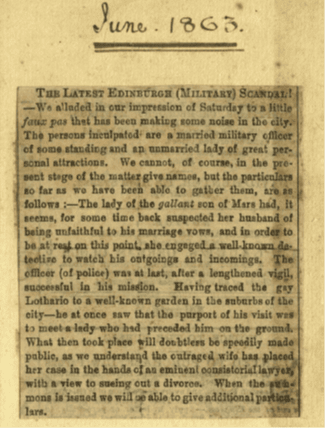
While Robert McIntosh was involving himself with soldierly duties, others in Edinburgh were titillated by the scandal of an officer of the 25th Regiment having liaisons with a lady in an Edinburgh park. The wife of the officer was understandably enraged and sensibly enlisted the help of an investigator to corroborate the story before she filed for divorce.
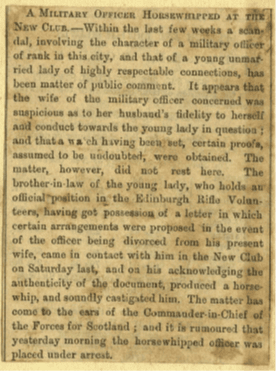
It is not long before the “gay lothario” receives further punishment for his misdemeanours, as his brother-in-law crosses paths with him at the New Club and gives him a severe whipping.
Although there are only four letters in Robert McIntosh’s archive folder, he manages to cram in plenty of factual information about the provisions for soldiers of that period, as well as hinting at the difficulties of being far away from home and separated from family. He gives the impression that he is coping better than his family with the distance between them, distracted from any feelings of homesickness by the hearty meals and roomy beds. He tells his father “I do not wish you to write me till you hear from me again” and, in a later letter, “I must confess that my fault of not writing to you for so long a time has been a broad breach of filial duty”. The family clearly disapproved of him going overseas with the Regiment, but Robert goes anyway, although he does tell them that “you may be sure that I am sorry myself for leaving my natural land”.
The concern from the McIntosh family is perhaps why Robert writes such a detailed list of clothing, equipment, and rations supplied to soldiers.
Two pairs of boots per year
One redcoat
Two pairs of trousers
Summer dress
Everything they require, such as soap, black or whitening, shoe brushes, clothes brushes, shaving articles…
Robert seems to have a good level of education. He is literate and writes well. There is mention of a maid in the family’s employment. His standard of living must have been good for the time, which feels important to consider when we see how impressed he is by the food and equipment provided.
Their rations are as good as I would wish to have. They have three meals per day.
Loaf and coffee at breakfast…
Potatoes, soup and beef at dinner…
Tea and loaf at supper.
They have breakfast at 8am and dinner at 1pm and supper when they want it. They have not to cook their rations but to get it cooked, only one of the mess men have to go and fetch it from the cookhouse.
And the sleeping arrangements seem to be more comfortable than expected.
They have very good beds, every man has his own bed which is about six feet long and three broad…
A mattress
A pillow
Two coarse sheets
Two blankets
A bed cover.
On 28th July, 1863, the 2nd Battalion left for Sri Lanka, then called Ceylon. Robert writes that, although he has some nerves about going abroad, “still I am willing to go there for if I take care of myself I shall be able to get on in my profession and earn both fame and promotion.” The battalion consisted of around 800 men, but with a surprising 63 women and 86 children accompanying them. By the time Robert writes in December 1865, he tells his father “I am in charge of the school of this attachment. The children of soldiers of the Regiment attend it and grown men who are desirous to learn. I have 13 children and 28 men on my books.”
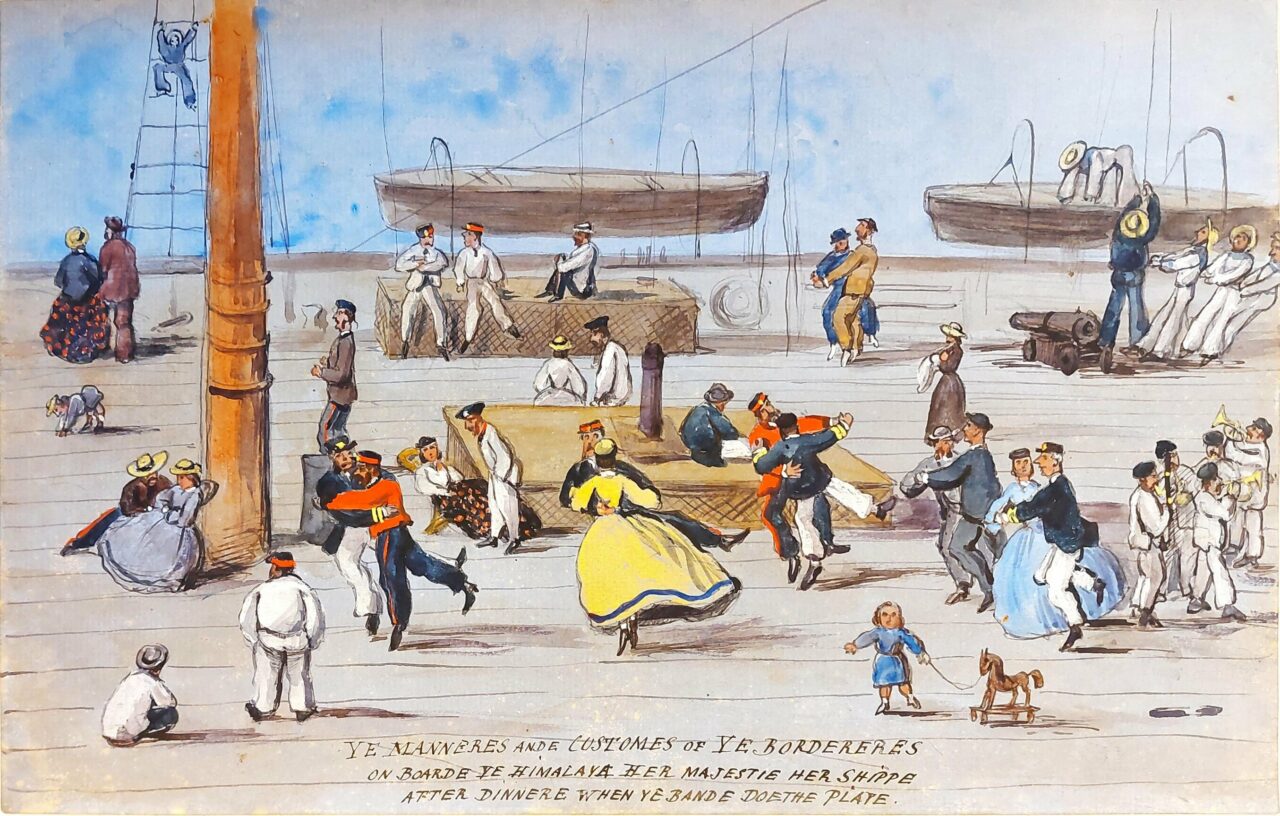
The presence of family hinted at by Robert McIntosh is illustrated in another painting by Coleridge. Although depicting a scene on the way to Canada a few years earlier, it shows the presence of women and children, laughter, dancing and community. Families were a big part of Regimental life – we know that there was even a midwife assigned to the 25th Regiment around this time.
Moving from a croft in Rogart, to Edinburgh, and then to Ceylon, Robert’s experience of the world must have increased dramatically in a short space of time. The experience in Ceylon detailed by Captain Turner in his scrapbook, includes many amateur concerts, plays, shooting competitions, and military gossip. It also includes the details of an accidental death in October 1865, when an officer who was aiming at a target, turned when he heard a noise behind him, and accidentally shot and killed a fellow officer. An outbreak of typhoid in 1868 would claim more lives. The final letter from Robert McIntosh ends differently to the others, with a change in tone and perhaps a sense of his own mortality.
I feel very happy and am living in the hope of heaven and all its glories through the merits of the redeemer who died and gave himself for us. I must now draw to a close. I wish you and the family and friends a very happy new year and with kind love to you all I remain, your affectionate son, Robert.
Leave a Reply